A hydrofoil ship uses submerged foils to generate lift as it gains speed, raising part or all of the hull above the water. With less of the hull in contact with the water, hydrodynamic resistance is reduced, making hydrofoils particularly attractive for high-speed, efficient marine applications. But achieving this performance also places specific demands on the propulsion system. In this article, we look at how hydrofoils work, the propulsion challenges they present, and how solutions such as VICUSdt’s counter rotating propellers can help address them.
Contenidos
- 1 What Is a Hydrofoil Ship and How Does It Work?
- 2 Why Are Hydrofoil Vessels More Efficient at High Speeds?
- 3 Hydrofoil Propulsion: Main Engineering Challenges
- 4 Hydrofoil Propulsion Systems: What Are the Main Options?
- 5 Main Applications of Hydrofoil Ships
- 6 Hydroglyder: Efficient Hydrofoil Propulsion in Practice
- 7 How CFD Improves Hydrofoil Propulsion System Design
- 8 How VICUSdt Develops Efficient Propulsion Solutions for Hydrofoil Vessels
What Is a Hydrofoil Ship and How Does It Work?
Hydrofoils are submerged lifting surfaces installed beneath the hull. As the vessel picks up speed, the flow of water around the foils generates lift, gradually raising the hull out of the water.
At lower speeds, the vessel operates in hullborne mode, much like a conventional boat. As speed increases and the foils generate enough lift, it transitions to foilborne operation, with the foils supporting most of the vessel’s weight. This reduces the hull’s contact with the water and, as a result, hydrodynamic drag.
How well hydrofoil vessels perform depends on several closely connected factors, including foil design, vessel weight, speed and stability. Propulsion also plays an important role, as the system needs to perform effectively across these different operating conditions. Hydrofoils can use a range of propulsion configurations, with electric systems becoming increasingly common in newer designs focused on efficiency and lower emissions.
Why Are Hydrofoil Vessels More Efficient at High Speeds?
Once a hydrofoil is operating in foilborne mode, most of the hull is lifted clear of the water. This significantly reduces the wetted surface and the hydrodynamic resistance that would otherwise increase as the vessel travels faster.
With less resistance to overcome, a well optimised vessel can require less power to maintain a given speed than a comparable conventional design. For electric hydrofoils, this can also help extend range and make better use of the energy available on board.
The benefits, however, depend on much more than the foils alone. Hull geometry, foil design and propulsion all need to work together and be matched to the vessel’s weight, speed range and operating profile. When these elements are properly integrated, hydrofoil vessels can combine high-speed performance with lower resistance and more efficient use of power.
Hydrofoil Propulsion: Main Engineering Challenges
Reducing hull resistance is only part of the equation. Hydrofoil propulsion brings its own engineering challenges, as the propulsion system has to deliver the required thrust within tight constraints on weight, space and propeller size. At the same time, it needs to perform efficiently across the vessel’s operating range and interact effectively with the foils and other submerged components.
Range and energy efficiency
Efficiency becomes particularly important in electric hydrofoils, where energy consumption has a direct impact on range and battery requirements. Increasing battery capacity can extend operating time, but it also adds weight, which in turn affects the vessel’s overall performance.
The propulsion system therefore needs to make effective use of the available power, generating the required thrust without placing unnecessary demands on the energy stored on board.
Power density and weight
Hydrofoils need propulsion systems capable of delivering high power without adding excessive weight or taking up more space than the vessel can accommodate. This becomes especially challenging in electric designs, where batteries, motors and propulsion equipment all contribute to the overall weight.
These factors need to be considered together from an early stage, as changes in weight can influence foil performance, power requirements and ultimately the design of the vessel itself.
Propeller diameter constraints
Space below the foils is often limited, restricting the diameter available for the propeller. The challenge is therefore to generate sufficient thrust from a compact propulsion arrangement without compromising efficiency.
This also makes the interaction between the foil, strut, propeller and surrounding flow particularly important. Their geometry and relative position influence the flow reaching the propeller and the way the propulsion system performs as a whole. These were some of the key engineering challenges VICUSdt addressed in the Hydroglyder project.
Cavitation, vibration and hydrodynamic interaction
High operating speeds can also increase the risk of propeller cavitation, with potential consequences for efficiency, vibration and the loads acting on the propulsion system.
The flow around a hydrofoil is influenced by several submerged components operating close to one another. Understanding how the foils, struts and propellers interact is therefore essential when assessing flow distribution and identifying sources of hydrodynamic excitation.
Careful hydrodynamic design helps manage these interactions, reduce unwanted vibration and maintain efficient, reliable propulsion across the vessel’s intended operating conditions.
Hydrofoil Propulsion Systems: What Are the Main Options?
There is no single hydrofoil propulsion system that works for every vessel. The right configuration depends on several factors, including the required speed and power, the vessel’s geometry, its intended application and the conditions in which it will operate.
These requirements can vary significantly from one project to another. A high speed passenger vessel, for example, may place different demands on propulsion than a military or cargo application. Available space, weight, efficiency targets and the arrangement of the foils also influence the choice.
For this reason, the propulsion system needs to be considered as part of the overall vessel design. Matching the propulsor and powertrain to the specific operating profile is essential to achieve the required performance without compromising efficiency, range or reliability.
Propellers and waterjets
Hydrofoil vessels can use different propulsion solutions, including propellers and waterjets. The choice depends on the vessel’s speed, power requirements, layout and intended operating conditions, as each option brings different advantages and design constraints.
Rather than selecting the propulsor in isolation, its performance needs to be considered alongside the hull, foils and overall vessel configuration. This is why the selection and optimisation of ship propulsion solutions should reflect the vessel’s actual operating profile and the conditions it will encounter in service.
Counter-Rotating Propellers for hydrofoil vessels
Counter-rotating propellers, or CRPs, use two propellers mounted coaxially and rotating in opposite directions. This arrangement allows the second propeller to recover part of the rotational energy left in the flow by the first, helping convert more of the available power into useful thrust.
CRP systems can also help balance some of the rotational forces and moments generated by a conventional single-propeller arrangement. This makes them particularly interesting for hydrofoils, where space below the foils can restrict propeller diameter while the propulsion system still needs to deliver high power within a compact installation.
For applications with these constraints, counter-rotating propellers for hydrofoil vessels can provide an effective way to increase power density while maintaining a strong focus on propulsive efficiency.
At VICUSdt, CFD is used to analyse the interaction between both propellers and the surrounding flow, allowing the CRP configuration to be developed around the specific geometry and operating conditions of each vessel. Rather than treating the propellers as isolated components, the optimisation considers how the complete system performs within the hydrofoil propulsion arrangement.
Main Applications of Hydrofoil Ships
Hydrofoil technology can be used across a range of vessel types, particularly in applications where speed, energy efficiency and range are important design considerations. The requirements can vary considerably between a hydrofoil navy ship, a hydrofoil cruise ship and a hydrofoil cargo ship, but they all share the need to balance hydrodynamic performance with an efficient and reliable propulsion system.
As the technology continues to develop, these applications are also creating new opportunities for hydrofoil vessels, especially where reducing resistance and making better use of the available power can bring significant operational benefits.
Hydrofoil Cruise Ships and Passenger Vessels
Passenger transport is one of the most promising applications for hydrofoil technology, particularly on routes where shorter journey times and frequent services are important. A hydrofoil cruise ship or passenger vessel can take advantage of reduced hydrodynamic resistance to operate efficiently at higher speeds, making the concept particularly relevant for ferries and coastal connections.
For passenger operations, performance is not only about speed. Comfort also matters, which makes vibration and noise important considerations when designing the propulsion system. Energy efficiency becomes equally important on vessels operating the same route several times a day, where energy demand has a direct impact on day-to-day operation.
Electric propulsion can be particularly attractive for some of these routes, depending on factors such as distance, charging infrastructure and the vessel’s operating profile. VICUSdt works with cruise, yacht and ferry vessels, applying hydrodynamic and propulsion engineering to the specific requirements of passenger applications.
Hydrofoils have a long history in naval and patrol applications, where their ability to reach high speeds has made them particularly interesting for fast-response operations. A hydrofoil navy ship can benefit from reduced resistance once foilborne, allowing the vessel to combine speed with the manoeuvrability required for demanding missions.
These applications also place significant demands on the propulsion system. Power-to-weight ratio is particularly important, as the vessel needs sufficient power without adding unnecessary weight that could affect overall performance. Propulsion efficiency, reliability and integration with the foils must therefore be considered together, along with noise and vibration where operational requirements make them relevant.
VICUSdt applies its hydrodynamic and propulsion expertise to navy and patrol vessels, taking into account the specific performance and operating requirements of each project.
Hydrofoil Cargo Ships
Hydrofoil technology is also being explored for fast cargo transport. A hydrofoil cargo ship, however, comes with a different set of design challenges, as cargo weight and payload requirements have a direct impact on the lift the foils need to generate.
As payload increases, so do the demands on the foils and the power required to lift the vessel and maintain efficient foilborne operation. Foil dimensions, propulsion power and range therefore need to be considered alongside the amount of cargo the vessel is expected to carry.
The key is finding the right balance between speed, payload and energy consumption. Recent hydrofoil cargo concepts show the potential of this approach for applications where moving goods quickly is a priority, while also highlighting the importance of optimising the vessel around its specific operating profile.
Hydroglyder: Efficient Hydrofoil Propulsion in Practice
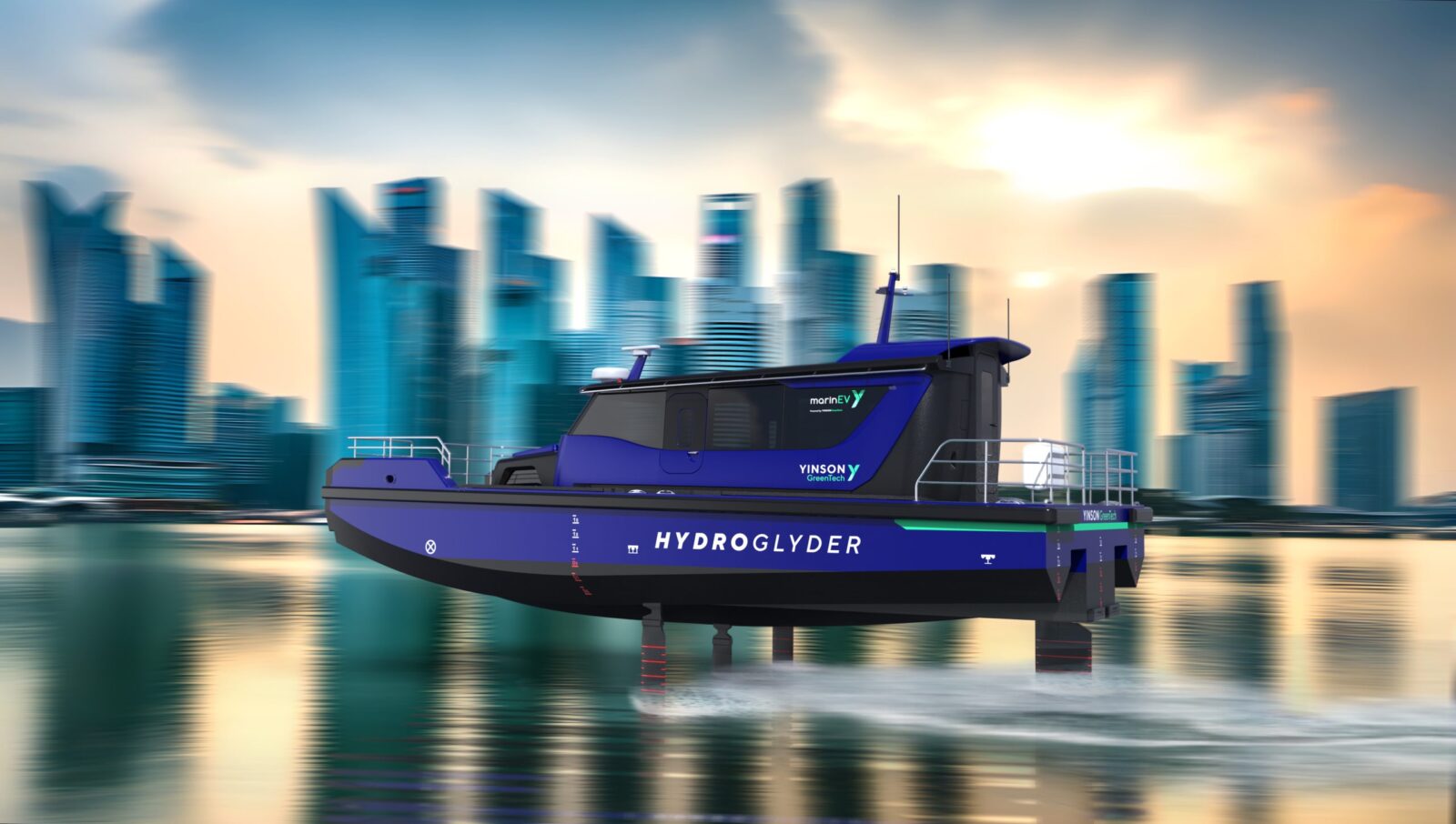
The Hydroglyder, developed by Yinson GreenTech, provides a practical example of how these propulsion challenges come together in a real project. Designed as a high-speed electric hydrofoil vessel, it required a propulsion solution capable of combining range and high power density within the space available below the foils.
Propeller diameter was one of the key constraints, making it necessary to generate the required thrust from a compact arrangement without compromising efficiency. To address this, VICUSdt developed a CRP system specifically for the vessel rather than adapting a conventional propeller configuration to the available space.
The design process relied on CFD to evaluate and refine the hydrodynamic performance of the propulsion system. Through successive iterations, the CRP configuration was adapted to the requirements of foilborne operation, where range, power density, available diameter and propulsive efficiency all needed to be considered together.
Hydroglyder shows why hydrofoil propulsion needs to be approached as an integrated engineering problem. The propulsion system has to be designed around the vessel itself, taking into account its geometry, operating conditions and the specific constraints that come with foilborne operation
How CFD Improves Hydrofoil Propulsion System Design
Computational Fluid Dynamics (CFD) makes it possible to study how a hydrofoil propulsion system will behave before the final design is manufactured. By simulating the flow around the propellers, foils, struts and other submerged components, engineers can see how each element influences the performance of the others.
For CRP configurations, CFD can be used to analyse the interaction between both propellers and refine their geometry based on predicted thrust, torque and overall propulsive performance. It also allows different operating conditions to be investigated, including the onset and development of cavitation, rather than assessing performance at a single design point.
This makes optimisation an iterative process. Different geometries and configurations can be evaluated and refined before manufacturing, helping engineers identify potential issues early and reduce design risk.
At VICUSdt, CFD hydrodynamics is used to look beyond the propeller itself and understand how the complete system behaves. This approach supports both hydrodynamic analysis and the design and optimisation of propellers and propulsion systems for the vessel’s actual operating conditions.
How VICUSdt Develops Efficient Propulsion Solutions for Hydrofoil Vessels
Every hydrofoil project comes with its own combination of speed, range, power, weight and space constraints. Developing an efficient propulsion system means understanding how these factors interact and designing around the vessel’s actual operating profile.
VICUSdt combines naval propulsion engineering with Computational Fluid Dynamics to develop and optimise solutions for each application. This includes propeller design services tailored to the vessel’s requirements, as well as analysing the interaction between the hull, propulsor and other components that influence hydrodynamic performance.
Through ship performance analysis, VICUSdt can also evaluate how the different elements of the vessel work together and identify opportunities to improve the overall performance and efficiency of the propulsion system.
If you are developing a hydrofoil vessel and need to evaluate or optimise its propulsion system, contact VICUSdt. Our team can analyse your operating requirements and develop a solution tailored to the vessel and its intended service.