Industries
We’ll be pleased to answer your questions
Ship design companies
VICUSdt is the naval hydrodynamics and propulsion engineering partner built for ship design companies that need specialist technical depth without the overhead of an in-house team. We integrate directly into your ship design process (from early concept to sea trials) delivering the CFD, propulsion, and optimization capabilities that today’s projects demand.
Naval hydrodynamic services provider
VICUSdt is not a technical ship design office, we are the specialist naval hydrodynamics partner that supports naval architecture firms throughout the entire vessel development process. From early concept to delivery, we provide the propulsion engineering knowledge, CFD capabilities, and optimization expertise that the market demands today, without the overhead of building that capability in-house.
Where most design offices rely on empirical methods or third-party model basin testing for hydrodynamic validation, VICUSdt brings high-fidelity CFD simulation, advanced propulsion analysis, and field measurement experience into your workflow as a seamless external resource. The result is faster design cycles, more accurate performance predictions, and stronger technical guarantees for your clients, without adding headcount or software investment to your organization.
Your support team
There is no need to expand your staff with specialist hydrodynamic engineers, CFD software licences, or expensive calculation equipment. VICUSdt engineers integrate seamlessly and efficiently into your project team from concept phase through to sea trials, acting as a transparent extension of your design office.
For ship design companies in Europe working under tight project timelines and fixed budgets, this flexible model delivers expert output at the right moment in the design cycle, without long-term resource commitments. You define the scope and the deadline, our engineers deliver. Whether you need a single power prediction study or continuous hydrodynamic support across a multi-vessel programme, the engagement adapts to your project, not the other way around.
Our ship design solutions:
VICUSdt covers the full range of hydrodynamic and propulsion engineering disciplines that naval design offices require across all vessel types and project phases. Our ship design solutions are structured to integrate directly into your workflow, whether you need a one-off CFD study or ongoing support across a multi-vessel programme.
- Power prediction in conceptual stage
- Evaluation of propulsion system alternatives
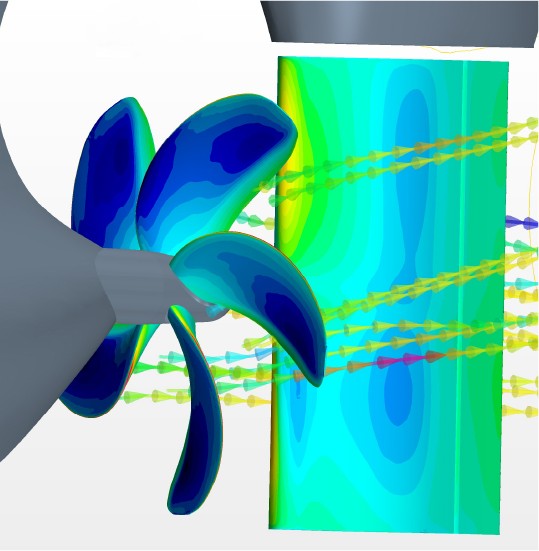
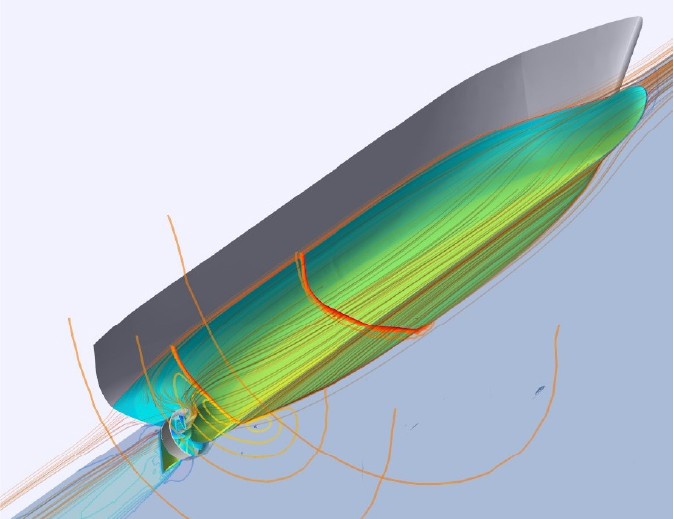
- CFD calculations of resistance and seakeeping
- Hull form optimization
- Aerodynamics
- Maneuverability
- Shaftline design and calculations
- Noise and vibrations
- Sea trials
Power prediction in conceptual stage
Reliable power estimates from the earliest design stage allow your team to evaluate hull form alternatives, select the right propulsion system, and provide credible performance guarantees to the shipowner, all before the first detailed drawing is produced.
Evaluation of alternative propulsion systems
We assess multiple propulsion configurations (conventional shaft lines, azimuth thrusters, hybrid systems, nozzle propellers) against your vessel’s operational profile, delivering a comparative analysis that supports informed decision-making at the system selection stage.
CFD calculations of resistance and seakeeping
High-fidelity CFD simulations of hull resistance and seakeeping behavior replace or complement model basin testing, providing your design team with accurate hydrodynamic data at a fraction of the cost and lead time of physical experiments.
Hull form optimization
Iterative CFD-driven hull form optimization reduces resistance, improves propulsive efficiency, and meets the increasingly stringent EEDI and CII targets demanded by classification societies and shipowners alike.
Aerodynamics
Wind resistance and aerodynamic drag analysis for vessels where above-water profile significantly affects fuel consumption and operability, ferries, RoPax, LNG carriers, and offshore support vessels.
Maneuverability
DP and maneuvering simulations covering tactical diameter, crash stop, and zig-zag performance. Results are validated against IMO standards and delivered in a format directly usable by your classification society submission.
Shaftline design and alignment
Shaftline design, bearing load calculations, and alignment optimization, ensuring mechanical reliability and minimizing vibration transmission from the propeller to the hull structure.
Noise & vibration
Noise and vibration assessment covering propeller-induced hull excitation, onboard comfort levels, and compliance with class society requirements, increasingly critical for passenger vessels and naval applications.
Sea trials
Full offshore performance trials covering shaft power, maneuverability, seakeeping, electrical measurements, and flow rates, closing the loop between design predictions and real-world vessel behavior.
Projects about any ship type
This cross-sector experience means that solutions developed for one vessel class are continuously applied and refined across others, delivering engineering insight that a single-sector design office cannot replicate.
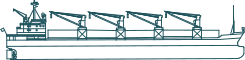
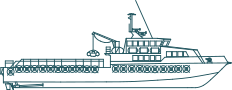
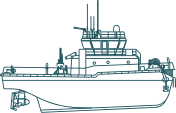
Our experience spans the full spectrum of commercial, fishing, and naval vessel types. Ship design companies in Europe and internationally have relied on VICUSdt across projects including:
Yachts
LNG carriers
Ferries
Dredgers
River barges
Oil tankers
Warships
Catamarans
Bottom and pelagic trawlers
Purse seiners
Bottom and surface longliners
Live fish carriers, etc.



Frequently asked questions
What services does VICUSdt provide to ship design companies?
VICUSdt provides specialist naval hydrodynamic and propulsion engineering support to naval architecture firms that need external expertise without building it in-house. Our services cover CFD resistance and seakeeping, power prediction, hull form optimization, propulsion system selection, shaftline design, noise and vibration analysis, and offshore performance trials, integrated directly into your project team at any design stage.
How does VICUSdt integrate into an existing design team?
VICUSdt engineers join your project as a transparent external resource, aligned to your timeline and documentation standards. We adapt to your CAD environment and file formats, attend project meetings as required, and deliver results in the format your team needs, whether that is a technical report, a set of CFD data files, or a recommendation memo for the shipowner.
Does VICUSdt work exclusively with large ship design companies?
No. Our flexible engagement model is specifically designed to make specialist hydrodynamic expertise accessible to design offices of all sizes. Small and mid-sized naval architecture firms benefit most from this model, as it gives them access to CFD capabilities and propulsion engineering depth that would otherwise require significant capital investment in software, hardware, and specialist staff.