Ship propulsion engineering
Ice Class Ships: Ice Load &Shock calculations
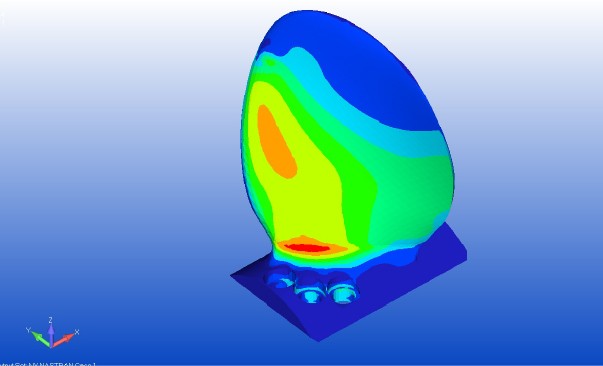
Vessels operating in Arctic waters or subjected to naval explosions require specific structural analysis before manufacturing components. To ensure compliance for ice class ships, shipyards must integrate ice load calculations and shock calculations. Consequently, the calculations of components for ships subjected to ice loads require the application of the new regulations of the classification societies. This requires the use of the finite element method for the analysis of the resistance of the blades as well as calculations of forced vibrations to evaluate torsional loads of ice.
What Are Ice Class Ships and Why Do They Require Special Calculations?
Ice class ships are vessels specifically designed to operate in icy waters such as the Baltic Sea, Arctic regions, and polar routes. Their hull structure, propulsion system, and onboard equipment are reinforced to withstand ice impact and low-temperature operating conditions. Classification societies such as DNV, Bureau Veritas, and Lloyd’s Register apply dedicated ice-class rules based on international standards developed by IACS. These regulations define structural requirements, machinery protection, and operational capabilities according to the expected ice conditions.
Special structural calculations are essential for propulsion components, particularly propeller blades, because they are directly exposed to extreme and irregular ice loads. When a propeller interacts with floating ice, the blades can experience sudden impacts, high cyclic stresses, vibration, and fatigue damage. Advanced finite element analysis (FEA) and hydrodynamic simulations are therefore required to verify strength, durability, and safety under ice-loading scenarios.
A typical civil application is found in modern ice-class expedition ships, which combine passenger comfort with the ability to safely navigate polar environments while meeting strict international classification requirements
Ice Load Calculations for Ship Propeller and Structural Components
Operating in ice covered waters exposes propulsion systems and structural components to highly demanding mechanical conditions that require advanced engineering verification. Specialized technical services are developed to evaluate the structural response of propeller blades and related components subjected to ice interaction loads. Using advanced Finite Element Method (FEM) simulations, engineers can accurately determine stress distribution, deformation behavior, and fatigue resistance under extreme operating scenarios. This analysis is essential to ensure that the propulsion system maintains structural integrity and reliability during navigation in polar environments.
In parallel, forced vibration and torsional calculations are performed to assess the dynamic behavior of shafts, propellers, and transmission systems under irregular ice induced excitation. When a propeller impacts floating or compact ice, sudden load variations can generate significant torsional stresses and vibration peaks capable of affecting long-term performance and safety. Detailed numerical simulations help identify critical frequencies, resonance risks, and transient load conditions that must be considered during the design phase.
All verification procedures are performed in accordance with international ice class regulations and classification requirements, including specialized applications such as modern ice class yacht propellers for expedition and luxury polar vessels.
Naval Shock Analysis and Design: Protecting Ships from Underwater Explosions
Shock calculations are a critical engineering service used to ensure that onboard systems and equipment can withstand extreme dynamic loads generated by underwater explosions or high energy impulsive events. These loads propagate through the ship’s structure as shock waves, causing rapid accelerations that can lead to structural damage, misalignment of machinery, or failure of sensitive electronic systems if not properly designed and verified.
A key part of this methodology is response spectrum analysis, which evaluates how different components react to a range of shock induced frequencies and acceleration levels. Instead of simulating a single transient event only, this approach transforms the shock input into a spectrum that represents peak dynamic responses across multiple frequencies. This allows engineers to identify resonance risks and determine whether equipment will amplify or attenuate specific shock loads depending on its natural frequency characteristics.
Naval shock analysis and design is therefore closely linked to naval seismic design principles, where equipment is engineered to maintain functionality under extreme transient accelerations. In naval applications, this involves ensuring that machinery, piping systems, control units, and structural supports are properly isolated or reinforced to reduce transmitted shock loads. Mounting systems, damping solutions, and structural reinforcements are optimized to prevent failure during high impact events.
This type of analysis is performed in accordance with established military and naval standards such as MIL-S-901D, STANAG 4141, NFR-90, and DEF-STAN 08-120, which define test procedures, acceptance criteria, and qualification requirements for shock-resistant naval equipment.
Full Ship Shock Trials: Scope and Simulation
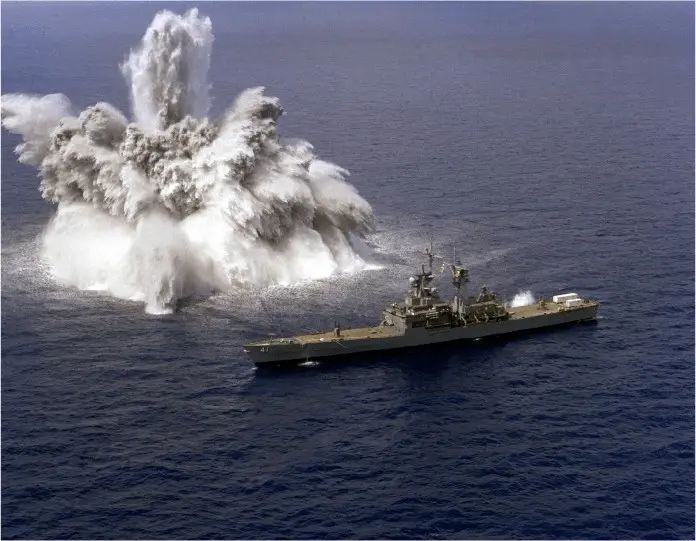
Full ship shock trials are large scale naval tests used to evaluate how a vessel and its onboard systems respond to extreme underwater shock events generated by controlled explosions. These full ship shock test procedures are typically carried out in advanced stages of ship construction to verify the structural integrity of the hull, propulsion systems, and critical equipment under real operational conditions. A navy ship shock test ensures that the vessel remains functional after exposure to high-energy shock waves and that no essential systems fail.
To support certification, advanced simulation and finite element analysis are used to replicate shock loads and assess the response of propulsion components. This allows engineers to identify weak points, optimize structural design, and improve system resilience before physical testing, increasing the likelihood of successfully passing full ship shock trials.
Applications: Which Vessels Require Ice and Shock Engineering?
Naval, ice, and offshore vessels require specialized ice and shock engineering services to ensure structural integrity under extreme conditions. Typical applications include military naval ships, icebreakers, expedition yachts operating in polar regions, oceanographic research vessels, and offshore platforms in Arctic environments. Each vessel type demands tailored analysis for propulsion systems, hull structures, and onboard equipment to withstand ice loads and underwater shock events. Detailed engineering support is provided across naval shock analysis, ice-class propulsion design, and offshore Arctic structures. These services ensure compliance, safety, and operational reliability across the most demanding marine environments