Ship propulsion engineering
Marine CFD Analysis Services: Special Fluid Dynamic Simulations
Modern naval engineering projects increasingly require advanced cfd analysis services and specialized marine cfd expertise to evaluate fluid behavior in systems beyond direct propulsion. Shipowners and marine engineers often need detailed simulations for cooling circuits, separation systems, discharge operations, water recovery processes, and other auxiliary onboard systems operating under demanding marine conditions. These analyses require a CFD specialist with specific experience in naval and offshore environments, where fluid interaction, operational safety, and system efficiency are critical. Complementary to propulsion engineering, these simulations help optimize onboard performance, reduce operational risks, and improve the reliability of complex fluid systems across a wide range of marine applications.
What Are Marine CFD Analysis Services?
Computational Fluid Dynamics (CFD) applied to marine environments uses advanced numerical simulation methodologies to study fluid behavior in onboard systems that are not directly related to ship propulsion. These simulations are widely used to evaluate cooling circuits, water intake systems, discharge operations, separators, ventilation flows, recovery systems, and other auxiliary processes where fluid interaction significantly affects operational performance and safety. Through detailed numerical modelling, CFD makes it possible to predict pressure losses, turbulent flow patterns, cavitation risks, air entrainment, thermal exchange, and flow distribution before installation or physical testing.
Compared with traditional experimental methods, CFD simulations provide a faster, more flexible, and cost efficient engineering solution. Physical prototypes and full scale testing campaigns are often expensive, time consuming, and limited in the number of operating conditions that can be analyzed. CFD analysis enables engineers to rapidly evaluate multiple design alternatives, optimize system geometry, and identify potential operational issues during early project stages, significantly reducing development risks and engineering costs.
As part of its cfd analysis consulting activities, VICUSdt acts as one of the marine cfd consultants supporting shipowners, shipyards, and naval design companies in the development and optimization of complex fluid systems for demanding offshore and naval applications.
VICUSdt as Your Marine CFD Consultant: Scope of Services
As a specialized CFD analysis consultant, VICUSdt provides advanced engineering support focused specifically on marine and offshore fluid systems. The team combines extensive experience in fluid dynamics naval applications with deep expertise in numerical simulation and marine engineering requirements. Unlike generic CFD providers, the approach is tailored to the operational conditions, regulations, and technical challenges of naval environments, including onboard auxiliary systems, offshore installations, and complex marine fluid interactions. This specialized knowledge allows the development of accurate, efficient, and application oriented CFD solutions for demanding maritime projects.
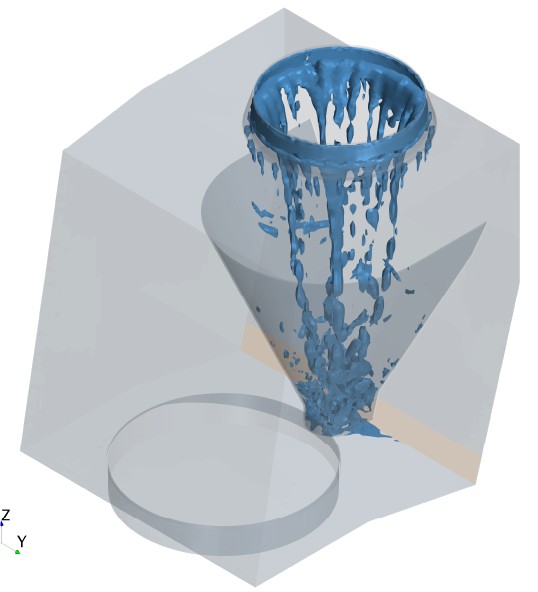
- Sea Chest CFD Analysis : Through CFD analysis, sea chest performance is evaluated by studying vortex formation, air ingestion, and sediment accumulation, which can reduce intake efficiency and damage downstream systems. Key metrics include velocity fields, pressure distribution, swirl intensity, and flow uniformity at the intake. These results help engineers detect unstable flow zones, optimize geometry, and ensure consistent water supply, reducing clogging risks and improving the reliability and efficiency of pumps, filters, and cooling systems.
- Box Cooler Flow Simulation
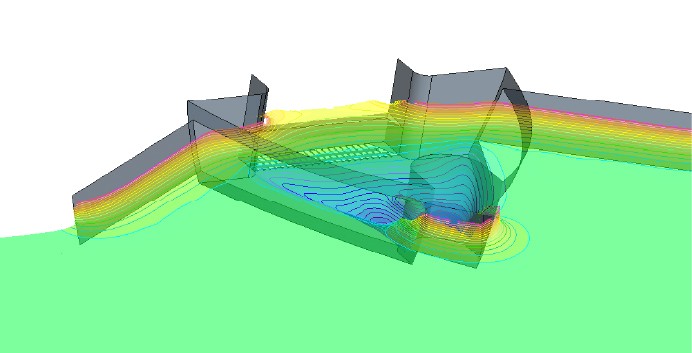
CFD evaluates water velocity distribution, heat transfer performance, stagnation zones, and optimizes flow channels to improve cooling efficiency. It is more accurate than empirical methods because it captures 3D flow behavior, turbulence, and local thermal effects that simplified correlations cannot predict. - Scrubber water cleaning CFD: CFD models fluid movement inside scrubber cleaning units, improving particle separation efficiency and preventing short circuiting flows. It helps ensure compliance with MARPOL discharge standards, supporting environmental regulations. Its relevance is increasing due to stricter marine emissions control requirements worldwide.
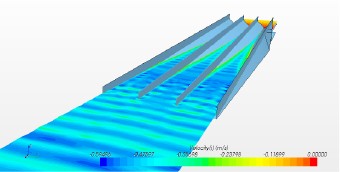
- Side discharges Analysis: The analysis evaluates discharge plume trajectories, velocity decay, and potential re ingestion into seawater intakes. It also assesses environmental impact by studying dispersion patterns, helping reduce contamination risks and improve the efficiency and safety of marine discharge operations.
- Oil recovery System CFD: The analysis evaluates separation chambers, skimmer performance, and sedimentation behavior to optimize hydrocarbon recovery efficiency. It improves phase separation, enhances collection effectiveness, and ensures compliance with pollution prevention regulations, reducing environmental impact in marine spill response operations.
- RSW Tank Flow and Other Special Simulations: RSW tank flow simulations evaluate thermal performance, circulation patterns, and temperature stability in refrigerated sea water systems. Other specialized CFD studies can be performed for custom marine applications and fishing vessel operations. fishing applications.
Why Choose a Specialist Marine CFD Analysis Engineer?
A specialist CFD analysis engineer with experience in marine environments provides a level of accuracy and reliability that generic CFD providers cannot match. Understanding real operating conditions at sea, including waves, loading variations, and system interactions, allows for more realistic and actionable simulations. Familiarity with classification society requirements ensures that designs are developed in line with applicable standards from the earliest stages, reducing rework and certification risks. In addition, marine focused engineers consider the integration between hydrodynamics, propulsion systems, and onboard auxiliary equipment, ensuring that all components work efficiently as a complete system rather than in isolation, improving overall vessel performance and safety.